
The A in Skincare: Staying in the A-Game
If we're doing the ABC of skincare, we have arrived at A. And A is the big one.
Vitamin A. Retinol. Retinal. Retinoids. Retinoic acid. Tretinoin. Retinyl something-or-other. There are enough names, percentages, conversions, prescription products and TikTok declarations surrounding Vitamin A to make a relatively sensible person decide they'd rather buy a moisturiser and go home. Which would be a shame, because if you asked me which skincare ingredient has the most compelling evidence behind its ability to actually change skin, Vitamin A would be very difficult to argue against.
Fine lines, wrinkles, collagen, texture, pigmentation, acne, cell turnover, photodamage. What doesn't it do? Not literally everything, obviously, and I don't want to become one of those people on the internet, but the list is long enough that Vitamin A has earned something approaching legendary status in skincare. Perhaps that is part of the problem. We have attributed some extraordinarily bold statements to retinoids. It changed my life. It destroyed my skin. Retinol is pointless. Tretinoin is the answer. Start at the bottom. Go straight to the strongest. No wonder we're confused.
So let's sort out the family without disappearing into a magnificent rabbit hole of retinyl esters and chemistry that most people don't need in order to choose their evening skincare. Retinoid is the surname. The 80% I want you to understand is this:
Retinol → Retinal/Retinaldehyde → Retinoic Acid
Those arrows matter. Ultimately it is retinoic acid that binds to retinoic acid receptors in the skin and influences gene transcription. Retinol needs two conversion steps to get there, retinal needs one, and tretinoin is retinoic acid, so requires none. This is also why comparing percentages without understanding the molecule is so unhelpful. A 1% retinol and a 0.1% retinal are not simply the same thing with one being ten times stronger. They are different forms of Vitamin A sitting at different points in the pathway. Percentage matters, but percentage without molecule tells you remarkably little.
What we recommend…
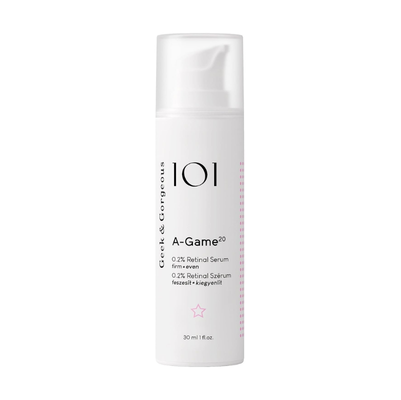
Geek & Gorgeous A-Game 20
High-strength cosmetic retinal at a frankly disruptive price, in an elegant and supportive formulation.
The Shelf: one of the products that made me properly notice Geek & Gorgeous. Serious retinal without the serious price tag, but absolutely not where everybody needs to start.
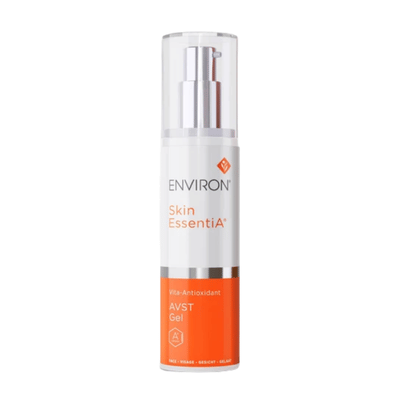
Environ Vitamin A
Less about one hero bottle and more an entire philosophy of progressive Vitamin A acclimatisation.
The Shelf: I respect the emphasis on tolerance enormously. Just remember that a brand pathway is still a brand pathway. Your skin gets a say.
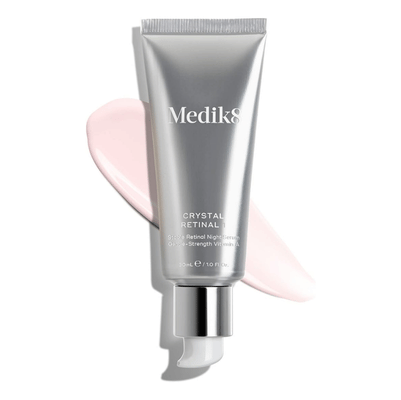
Medik8 Crystal Retinal
Beautiful formulations, intelligent stabilisation and probably the clearest progression model in the category.
The Shelf: excellent retinal and excellent brand architecture. I like the ladder considerably more than I believe everybody needs to obediently climb every rung.
And then there is a line I think we need to draw much more clearly: tretinoin is a prescription medication, not a cosmetic skincare product. That doesn't make tretinoin frightening and it doesn't make cosmetic retinoids pointless. It simply means we should stop discussing a prescription medicine and a bottle of retinol as though the only difference between them is strength.
The evidence behind tretinoin is where Vitamin A becomes particularly difficult to dismiss. It has been investigated in clinical trials for decades, with evidence for improvements in fine and coarse wrinkling, mottled pigmentation and other signs of photodamage, alongside measurable changes in collagen and epidermal behaviour. Retinaldehyde has clinical evidence of its own, including studies at concentrations of 0.05% and 0.1%. This isn't an ingredient that became famous because somebody had good lighting on TikTok. The evidence came first.
And the biology is rather wonderful. Retinoic acid interacts with nuclear receptors and changes gene expression, so we are not simply smoothing the surface of the skin and enjoying a temporary cosmetic effect. Retinoids influence epidermal turnover and keratinisation, collagen production and degradation, pigment distribution and what is happening inside the follicle, which is why Vitamin A has such an established role in acne as well as photoageing. When I say it does almost everything, I'm being slightly playful. But only slightly.
The difficulty is getting all of that potential onto somebody's skin consistently enough to benefit from it, because the same family of ingredients capable of producing those results can also give us dryness, redness, peeling, burning and irritation. Retinoid dermatitis is real, particularly when somebody starts too aggressively, increases too quickly, uses too much or combines Vitamin A with a routine already doing seventeen other exciting things.
Social media has somehow turned this into two opposing camps. One is terrified of retinoids because somebody's face apparently fell off on TikTok. The other is treating tretinoin like an Olympic sport. Neither is particularly helpful. The strongest retinoid you can physically tolerate is not automatically the best retinoid for your skin, but equally I don't believe everybody needs to spend years creeping through microscopic increases because a brand has created a twelve-step ladder and told them that is the responsible route.
Your skin is not somebody else's marketing funnel.
This is where I think we need to be grown-up about conversions too. Retinal being only one conversion away from retinoic acid makes it a very compelling cosmetic Vitamin A, but that doesn't automatically make every retinal better than every retinol. Concentration matters, formulation matters, stability matters, delivery matters and your skin absolutely matters.
More than any of those, though, consistency matters.
If there is an A-game with Vitamin A, it is time, patience and discipline. Skin remodelling takes time. The 0.05% retinal you use happily and consistently may give you considerably more than the 0.1% you repeatedly start, irritate yourself with, stop, repair, restart and eventually decide "doesn't agree with your skin". Equally, if you're tolerating a lower strength beautifully and there is a reason to progress, don't be frightened of the next number. You can move. Just don't confuse progression with winning.
And this is where the brands become interesting, because they aren't simply selling us Vitamin A. They're also selling us a philosophy about how Vitamin A should be used.
Medik8 Crystal Retinal is perhaps the clearest example. It has built an extraordinarily successful retinal ladder, from 0.01% through to 0.24%. There is a lot I like about this. Retinal is difficult to stabilise, the formulations are elegant, the packaging and delivery technology are considered, the concentrations are transparent and Medik8 has done something commercially very clever: it has made progression through Vitamin A feel understandable. That has real value. I just don't think the ladder is scripture. Not everybody needs every rung, and nobody needs the top rung simply because their friend has reached it.
Then Geek & Gorgeous A-Game 20 wanders into the same conversation with 0.2% retinaldehyde, 1% ectoin and a supportive formula for £21.95, and this is where I start asking questions. The slightly English-mustard colour, faint earthy smell, airtight pump and elegant texture don't feel like a compromise product. It feels serious. And the inclusion of ectoin makes enormous sense to me when we're asking skin to tolerate a high-strength retinal.
Holy moly, Geek & Gorgeous.
It doesn't prove that premium retinal is a rip-off. Medik8 has invested in proprietary stabilisation, formulation technology and research, and those things have value. What A-Game does is force us to ask a much more interesting question about what we're actually paying for: molecule, formulation, stability and evidence, or brand architecture and positioning? Usually, of course, it is some combination of all of them.
Environ approaches Vitamin A from another direction again, with acclimatisation and progressive levels built into the bones of the brand. I understand the logic and I respect the emphasis on tolerance and barrier health. Where I become more questioning is when a sensible methodology starts being interpreted as a biological rule. Your skin doesn't know it is on Step 2. Different history, different tolerance, different starting point, different story.
And then services such as POM take us over an important line. Once tretinoin enters the conversation, we are talking about prescription medicine, assessment, contraindications, concentration, vehicle, frequency and adverse effects. I actually like having that boundary. Prescription shouldn't mean better skincare. It means prescription medicine. Those are not the same thing.
So if you ask me which Vitamin A you should use, I don't know yet. I want to know what you've used before, what your skin is like, what else is in your routine, what you're trying to achieve and whether your barrier is currently healthy enough for the conversation we're about to have.
There is no prize for owning the strongest retinoid. There is a result from finding the right one and using it consistently for long enough.
That is the A-game.
Vitamin A might be the closest thing skincare has to an ingredient that can claim to do almost everything. Almost. But perhaps the most important thing I've learned about it is that power is useless without consistency. Conversions matter. Percentage matters. Formulation matters. Your barrier matters. And time matters enormously.
Don't be frightened of progressing when there is a reason to progress. Equally, please don't leap to the strongest thing you can get your hands on because your mate in the pub used it for three months and apparently woke up with a new face
