
Tranexamic Acid: The Pigmentation Ingredient Everyone Forgot to Invite
Pigmentation does not have one front door.
It has several pathways, several triggers and a frankly irritating habit of returning just when you think you have finally evicted it.
So why are we still sending one ingredient to deal with the whole building?
Tranexamic acid is one of the most overlooked ingredients in a multi-pathway pigmentation plan. Possibly because it is not as famous as vitamin C, not as dramatic as a retinoid and does not provide the instant gratification of an exfoliating acid.
But if you are researching pigmentation, TXA deserves a place on the list.
And before we go any further, the word acid does not make it exfoliating. If every ingredient with acid in its name is still living inside one slightly terrifying box in your mind, please return to the ACIDS section.
What does tranexamic acid actually do?
TXA was originally developed as a medicine used to reduce bleeding. In skincare, we are interested in a different part of its biology.
It acts on the plasminogen and plasmin pathway, helping interrupt inflammatory signalling between keratinocytes and melanocytes. In simpler language, it turns down some of the messages encouraging pigment-producing cells to make excess melanin.
That makes it particularly interesting for melasma and post-inflammatory hyperpigmentation.
Clinical reviews support topical TXA as a promising pigmentation treatment, but the studies remain relatively small and use different concentrations, formulations and combinations. The evidence is strongest for melasma, rather than every mark that happens to be brown.
TXA is not the whole pigmentation plan. UV, visible light, inflammation, hormones and melanogenesis can all be involved.
One ingredient cannot negotiate with all of them simultaneously.
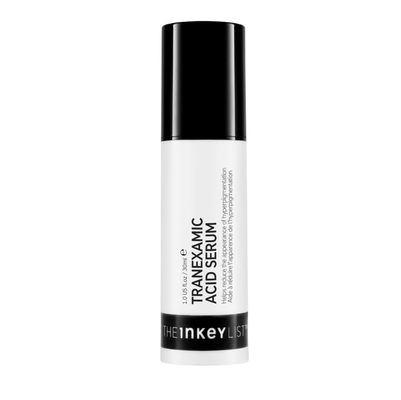
The INKEY List 2% Tranexamic Acid Serum
An overnight treatment formulated with 2% tranexamic acid alongside acai berry extract and a vitamin C derivative, designed to target hyperpigmentation, dark spots and uneven skin tone. Tranexamic acid works by disrupting the pathway that triggers excess pigment production, without disturbing the skin barrier. Applied as the last step before sleep, in place of a moisturiser, and best suited to those focused on tone evenness and post-inflammatory marks.
The Inkey List Tranexamic Acid Serum
For £17, we get:
2% tranexamic acid
2% acai berry extract
2% vitamin C derivative
30 ml of product
The texture is unusual. It resembles something I cannot describe on a respectable skincare website, and it smells slightly like the rubber on the end of a pencil.
But once we move past that, I like it.
It is lightweight, spreads easily and absorbs without remaining particularly sticky or clinging to everything applied afterwards. For a targeted serum at this price, it fits into a routine without making a grand performance out of being there.
The Inkey List currently reports a rating of 4.2 from more than 330 reviews. Many users describe gradual improvement in dark spots and post-blemish marks, alongside a smooth, non-sticky finish. Others report needing much longer to see change, experiencing sensitivity or having arguments with the pump.
That variation feels realistic.
Pigmentation treatment should be measured in months, not three emotionally charged mornings standing two inches from the bathroom mirror.
There is one formulation detail I would like clarified. The website describes the vitamin C component as magnesium ascorbyl phosphate, while the published ingredient list currently names ascorbyl glucoside. Both are vitamin C derivatives, but I would prefer the product story and the bottle to be having the same conversation.
Then Paula’s Choice enters the building
This is where the comparison becomes genuinely interesting.
Paula’s Choice Clinical Discoloration Repair Serum contains:
3% tranexamic acid
5% niacinamide
0.5% bakuchiol
£55 for 30 ml
This is not simply a more expensive TXA serum. It is a deliberately multi-pathway pigmentation formulation.
Tranexamic acid helps reduce signalling associated with excess melanin production.
Niacinamide works differently, partly by reducing the transfer of melanosomes from melanocytes into surrounding keratinocytes.
Bakuchiol brings antioxidant and cell-signalling activity. It is not a retinoid, and calling it “natural retinol” is an oversimplification. But there is clinical evidence supporting its use for photoageing and hyperpigmentation.
A 12-week randomised, double-blind trial compared 0.5% bakuchiol twice daily with 0.5% retinol once daily in 44 participants. Both significantly improved hyperpigmentation and wrinkles, while retinol caused more scaling and stinging.
That does not make the two ingredients interchangeable. The study was small and the dosing schedules were different. But Paula’s Choice uses the same 0.5% bakuchiol concentration investigated in that trial.
That is more meaningful than discovering an undisclosed amount hiding near the bottom of an ingredient list.
There is also randomised, vehicle-controlled evidence showing that a combination of niacinamide and TXA reduced irregular pigmentation beyond sunscreen alone.
We do not have a large independent clinical trial proving that this exact bottle produces the sum of every individual study. But the formula has a credible rationale.
These are not three fashionable ingredients forced into the same room because marketing had space left on the box. They are approaching pigmentation through different doors.
And I love that.
The supporting formula also contains glycerin, vitamin E, allantoin, non-fragrant plant oils, lecithin and soybean sterols. Although this is a corrective serum, it has not forgotten that irritated skin can create further pigment.
Customer feedback is positive but not worshipful. The UK and European product sits around four stars, with users reporting gradual fading and a smoother, more even appearance. Others see little change or struggle to justify the price. Paula’s Choice gives an eight to twelve-week timeframe and acknowledges that persistent conditions such as melasma may relapse when treatment stops.
That honesty matters.
A £55 serum cannot outwit hormones, inflammation, UV and visible light while sunscreen sits untouched in the bathroom cabinet.
And what about Anua?
Anua Niacinamide 10% + TXA 4% Serum is another multi-pathway option, combining:
4% tranexamic acid
10% niacinamide
Arbutin and alpha-arbutin
Ceramide NP, panthenol and multiple forms of hyaluronic acid
Anua currently reports a 4.7 rating from more than 600 reviews, with recurring praise for improvements in post-acne marks and uneven tone. It is an ambitious formula and gives us more TXA for considerably less money than Paula’s Choice.
But 10% niacinamide is not automatically better for every skin. For resilient skin wanting several pigmentation pathways addressed in one product, Anua makes sense. For reactive or rosacea-prone skin, it may be more than I would choose as a starting point.
Concentration matters. Formulation matters. So does the face wearing it.
So which one earns a place?
The Inkey List is the accessible starting point. It gives us a clearly disclosed 2% TXA formula that is easy to use and reasonably elegant once we forgive the smell and slightly questionable texture.
Anua is the higher-strength, busier option for someone wanting niacinamide, TXA and arbutin working within one formula.
Paula’s Choice is the most strategically balanced of the three. The 3% TXA, 5% niacinamide and 0.5% bakuchiol combination is thoughtful, evidence-aware and designed around pigmentation as a multi-pathway problem.
But it is £55.
That does not automatically make it better. It makes it more comprehensive, and whether that is worth paying for depends on what the rest of the routine is already doing.
The Shelf verdict
I like The Inkey List because it makes an underused ingredient accessible without turning the bathroom into a chemistry practical.
But Paula’s Choice may be the formula that best explains why TXA matters.
Pigmentation rarely needs one heroic ingredient charging into battle alone. It needs several sensible ingredients, each understanding which door they are supposed to cover.
Whichever product you choose, give it at least eight to twelve weeks and use daily broad-spectrum sunscreen.
Otherwise, treating pigmentation is a little like repeatedly mopping the floor while leaving the tap running.
The Inkey List: Best accessible starting point
Anua: Best for resilient skin wanting a stronger multi-pathway formula
Paula’s Choice: Best considered combination, with a price to match
Shelf status: TXA is no longer waiting outside. It has officially been invited in.
