
The C in Skincare: Finding Your Vitamin C Ride or Die
If we are going to do the ABC of skincare, then this is C. Vitamin C. And surely this should be the easy one because everybody knows Vitamin C, don't they? Brightening. Antioxidant. Collagen. Pigmentation. Morning serum. SPF. Done.
Except Vitamin C isn't an easy little active at all.
Having used quite a few of them now, I think Vitamin C might actually be one of those ingredients where finding your product matters far more than finding the product. It is volatile, surprisingly particular and definitely not the easy friend you can abandon for six months and expect to pick straight back up exactly where you left off. Finding your Vitamin C ride or die can take some work.
And before we get anywhere near the bottles, we need to talk about what we actually mean when we say Vitamin C, because seeing those two words on the front of a serum doesn't necessarily tell you what is inside it.
L-ascorbic acid is the big one.
It is the biologically active form of Vitamin C and the form with the most established research behind its topical use. When you hear "pure Vitamin C", this is generally what we are talking about. It is also the form against which the enormous family of Vitamin C derivatives tends to be compared.
And there are good reasons we like it.
Vitamin C is an antioxidant, meaning it can donate electrons to help neutralise reactive oxygen species and reduce oxidative stress. UV is a major source of this, which is why Vitamin C and SPF make such good morning companions, but I want to be really clear about what we mean by that. Vitamin C is not sunscreen. It isn't replacing SPF and it isn't stopping UV reaching your skin. Think of it as another part of the defence system, helping to deal with some of the oxidative fallout.
Then there is collagen, and this is more than another nice claim to put on the box. Vitamin C acts as a cofactor for enzymes involved in collagen synthesis and stabilisation. So when we talk about Vitamin C in the context of skin ageing, there is real biology behind that conversation.
And then pigment. Vitamin C can interfere with melanogenesis, including activity around tyrosinase and the processes involved in melanin formation. I really like it within a pigmentation plan for exactly that reason. Would I expect Vitamin C alone to sort complex pigmentation? No. Pigmentation has far too many pathways for me to expect one serum to heroically march in and deal with all of them. But it absolutely deserves a seat at the table.
We recommend…
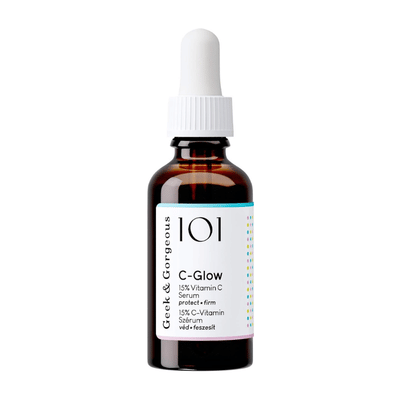
Geek & Gorgeous C-Glow
Watery, lightweight and ridiculously good value. The brand is refreshingly transparent about the stability problem, making it fresh weekly and recommending refrigeration.
The Shelf: my value winner and one of the formulations that made me take Geek & Gorgeous very seriously.
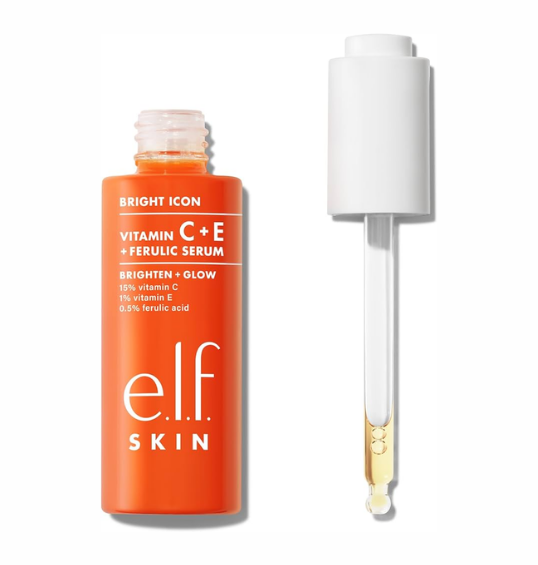
e.l.f. SKIN
Bright Icon
An awful lot going on for £17 and far more interesting than its price suggests. I enjoyed using it, although my reactive skin wasn't entirely convinced.
The Shelf: budget does not mean basic. Worth looking at, but tolerance still wins.
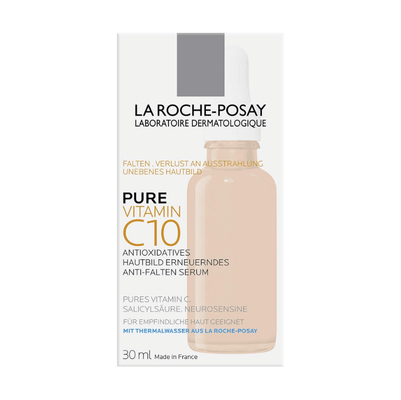
La Roche-Posay Pure Vitamin C10
A sensible concentration from a dermatological brand and one I expected to like. Mine oxidised, and with Vitamin C I can't pretend that doesn't matter.
The Shelf: the formulation made sense. My bottle didn't survive the relationship.
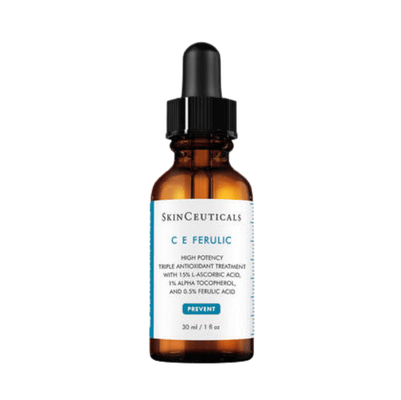
SkinCeuticals C E Ferulic
The icon. The research and formulation history matter and it deserves its place in the story. It is also an investment and I don't believe everybody needs to make it.
The Shelf: benchmark formulation, beautiful science, luxury price.
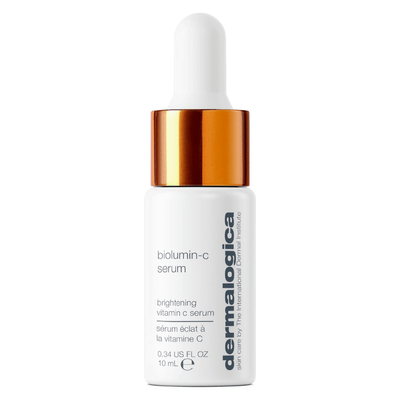
Dermalogica BioLumin-C
A much broader formulation rather than a pure L-ascorbic acid story. Elegant and perfectly pleasant, but it didn't leave enough of an impression on me to make £96 feel exciting.
The Shelf: good product, interesting formulation, strangely forgettable.
So L-ascorbic acid is doing some genuinely clever things.
Unfortunately, it is also a bit of a pain in the backside.
For L-ascorbic acid to penetrate the skin effectively, pH matters. Our skin is a very good barrier and L-ascorbic acid is a water-soluble molecule. The classic topical Vitamin C research established some parameters that still shape formulations today: pure L-ascorbic acid, generally somewhere within the 10–20% concentration range, formulated below approximately pH 3.5. SkinCeuticals still describes those same principles in relation to its Vitamin C technology today.
And suddenly the stinging some people experience makes a little more sense.
That acidic environment isn't there because formulators enjoy making your face tingle. It helps make L-ascorbic acid available to the skin. But the environment that helps delivery can also make a product less comfortable for reactive or compromised skin.
Then there is concentration. This is another place where I think skincare's obsession with bigger numbers can get us into trouble. Somewhere between 10 and 20% is where the interesting evidence for L-ascorbic acid sits. More doesn't simply mean proportionally more benefit.
So 20% isn't automatically "advanced". Fifteen percent isn't automatically inferior. And if somebody launched a 30% L-ascorbic acid serum tomorrow, my first thought wouldn't be excellent, more Vitamin C.
I'd want to know why.
More is so often not more.
And as if L-ascorbic acid hadn't already asked enough of us, we arrive at its biggest personality trait.
It is volatile.
Light? Not keen.
Air? Also problematic.
Heat? No thank you.
Water? Formulation challenge.
Leave an aqueous L-ascorbic acid serum hanging around for long enough and oxidation becomes a very real problem. Sometimes you can actually watch it happening. What started clear or very pale begins to move through yellow, orange and eventually brown.
Which brings me to something that I don't think gets nearly enough attention in skincare reviews.
Packaging matters more than you think.
I know. Packaging isn't sexy science. But with a volatile active, we cannot turn the bottle around, get excited by the ingredient list and decide our work is done. How that formula is protected from light, air and heat, how it is stored and how long it sits open in your bathroom all matter.
A packaging problem can eventually eclipse a perfect product.
And this is probably where we need to give SkinCeuticals C E Ferulic its flowers, because you cannot really tell the modern Vitamin C story without it.
Fifteen percent L-ascorbic acid, 1% alpha-tocopherol, our Vitamin E, and 0.5% ferulic acid.
Those additions aren't decorative.
Vitamin C is water soluble while Vitamin E is lipid soluble, so we're bringing antioxidant activity into different environments. Vitamin C can also help regenerate oxidised Vitamin E, while ferulic acid contributes its own antioxidant activity and improves the stability and performance of the combination. There is proper formulation science behind why those three ingredients became such a famous trio.
SkinCeuticals led the way here for a time. Arguably it still provides one of the benchmarks against which other L-ascorbic acid serums are measured.
I've used it. I understand why it became iconic. And I think we should be able to acknowledge that without automatically concluding that everybody therefore needs to spend SkinCeuticals money on Vitamin C.
Because your skin gets a vote too.
If your beautifully researched 15% L-ascorbic acid makes your face sting every morning, your skin becomes increasingly irritated, you start avoiding it and eventually discover it three months later behind the toothpaste looking suspiciously like weak tea, was that really the superior choice?
I'm not sure it was.
And this is where Vitamin C derivatives become much more interesting.
There are lots of them, and they are not all the same. You'll see names such as ascorbyl glucoside, sodium ascorbyl phosphate, magnesium ascorbyl phosphate, tetrahexyldecyl ascorbate and others. They have been modified in ways that can improve things such as stability, solubility or formulation behaviour.
What I don't want to do is flatten all of that into "Vitamin C is Vitamin C", because it isn't. Nor do I want to suggest that every derivative has an evidence base equivalent to L-ascorbic acid. It doesn't.
L-ascorbic acid remains our heavyweight.
But skincare doesn't happen in a laboratory.
If a beautifully formulated derivative is stable, your skin loves it and you use it every single morning, while the theoretically superior L-ascorbic acid irritates you enough that you use it four times and give up, I know which one I would rather you owned.
Consistency is part of efficacy.
And I think we forget that.
Which brings me back to the actual bottles, because I have now lived with quite a few versions of this ingredient and they have been surprisingly different.
Geek & Gorgeous C-Glow might be the one that made me question price versus formulation the most. It is £11.95 for 30ml and gives you a water-light 15% L-ascorbic acid formula with ferulic acid and a smaller amount of Vitamin E. But what I really like is that Geek & Gorgeous doesn't pretend stability isn't a problem. It makes C-Glow fresh every week, openly calls it a short-shelf-life product and recommends refrigeration to prolong its life.
There is something refreshingly unglamorous about that.
It isn't dressing Vitamin C up as luxury. It is treating Vitamin C like Vitamin C. The chemistry is slightly annoying, so look after it.
I really like that.
Then we have SkinCeuticals C E Ferulic, the icon. The 15% L-ascorbic acid, 1% Vitamin E and 0.5% ferulic acid formula remains important because there is history, evidence and intelligent formulation behind it. It is also very expensive.
Does Geek & Gorgeous costing a fraction of the price somehow erase what SkinCeuticals achieved? No. That's far too simplistic. But it does make the comparison fascinating because now we can start asking what we're paying for, what matters in a Vitamin C formula and whether everyone needs the benchmark product to get something worthwhile.
Dermalogica BioLumin-C takes us somewhere else. It currently uses the Vitamin C derivatives Ascorbyl Methylsilanol Pectinate and Aminopropyl Ascorbyl Phosphate, alongside lactic acid, Palmitoyl Tripeptide-5, sodium hyaluronate and Vitamin E. It's £96 for 30ml.
I didn't dislike it.
And perhaps that's my problem.
It was pleasant. It felt well made. I used it. And then I didn't particularly think about it again.
At £96 I think I'm allowed to want a stronger feeling than that was nice. There is absolutely a case for a derivative-based formula, particularly when we're talking about stability and tolerability, but this one just didn't stay with me.
Then e.l.f. Bright Icon comes barging into the conversation at £17 for 30ml, with 15% Vitamin C, 1% Vitamin E and 0.5% ferulic acid, plus bisabolol.
And this is why I love actually testing products rather than deciding what I think about them from the price.
It's accessible, light, easy to use and I liked it more than I expected to. My own skin was slightly less enthusiastic and I experienced some irritation.
That matters.
But it doesn't mean the product is bad.
My irritation doesn't make it a bad formulation any more than somebody else's glowing review makes it automatically right for my face.
Good and good for you are not the same thing.
And finally, La Roche-Posay Pure Vitamin C10. Ten percent pure Vitamin C in a 30ml serum, positioned specifically towards sensitive skin. On paper, this should have been very much my sort of Vitamin C.
But mine oxidised.
And once you've watched that happen, all of the conversation about light, air, temperature, formulation and packaging suddenly feels considerably less academic.
The changing serum became part of my experience of the product.
In some ways, it became the review.
So after trying all of these, I'm actually less interested in telling you which Vitamin C is best.
I want to know which form is in it. If it is L-ascorbic acid, I want to know the concentration. I want to understand the formulation around it. I want to look at the packaging. I want to know whether your skin tolerates it and, perhaps most importantly, whether you're actually going to use it.
The strongest Vitamin C isn't necessarily your best Vitamin C. The most expensive certainly isn't automatically the best one for you. And a derivative isn't automatically the poor relation simply because L-ascorbic acid has more research behind it.
Vitamin C absolutely earns the C in our ABC. The antioxidant science is good. The collagen story has genuine biology behind it. Its place in pigmentation makes sense. And a well-formulated Vitamin C can be a brilliant part of a morning routine alongside SPF.
But this one requires a little more effort.
Find your ride or die. Look after it. Actually use it.
And for the love of L-ascorbic acid, don't leave it on a sunny bathroom windowsill.
The Vitamin Cs on The Shelf
Geek & Gorgeous C-Glow | 30ml | £11.95
15% L-ascorbic acid + ferulic acid + Vitamin E
Watery, lightweight and ridiculously good value. The brand is refreshingly transparent about the stability problem, making it fresh weekly and recommending refrigeration. The Shelf: my value winner and one of the formulations that made me take Geek & Gorgeous very seriously.
SkinCeuticals C E Ferulic | 30ml
15% L-ascorbic acid + 1% Vitamin E + 0.5% ferulic acid
The icon. The research and formulation history matter and it deserves its place in the story. It is also an investment and I don't believe everybody needs to make it. The Shelf: benchmark formulation, beautiful science, luxury price.
e.l.f. Bright Icon Vitamin C + E + Ferulic | 30ml | £17
15% Vitamin C + 1% Vitamin E + 0.5% ferulic acid + bisabolol
An awful lot going on for £17 and far more interesting than its price suggests. I enjoyed using it, although my reactive skin wasn't entirely convinced. The Shelf: budget does not mean basic. Worth looking at, but tolerance still wins.
Dermalogica BioLumin-C | 30ml | £96
Vitamin C derivatives + lactic acid + peptide + Vitamin E + sodium hyaluronate
A much broader formulation rather than a pure L-ascorbic acid story. Elegant and perfectly pleasant, but it didn't leave enough of an impression on me to make £96 feel exciting. The Shelf: good product, interesting formulation, strangely forgettable.
La Roche-Posay Pure Vitamin C10 | 30ml
10% pure Vitamin C
A sensible concentration from a dermatological brand and one I expected to like. Mine oxidised, and with Vitamin C I can't pretend that doesn't matter. The Shelf: the formulation made sense. My bottle didn't survive the relationship.
