
Medicube Zero Pore Pads
AHA. BHA. Holy smokes, these guys are pulling their weight. Or is it packing their weight? I don’t know. But if there is one product I have chatted about more than most in 2026, it is probably these.
And honestly, it isn’t even for the reason you might expect.
Most of the time I am talking about them to tell people:
THERE ARE OTHER VERSIONS APART FROM THE DARK BLUE ONES.
Can we talk in flavours? Does anyone else talk about skincare in flavours?
Dark blue. Light blue. That cute yellow-ish colour.
Because they are different. They are absolutely not created equal. I actually like them all, but they do different jobs, for different skin, and some of them pack a fairly serious punch.
So first, let’s talk EXFOLIATION.
Gosh, I grew up in the era of the scrub.
You know the ones. Thick. Drying. Gritty. You would rub them into your face with the enthusiasm of somebody sanding a garden bench and just pray one of those little gritty bits didn’t get in your eye.
Yep. That was me.
Thankfully, exfoliation has moved on.
What we rate
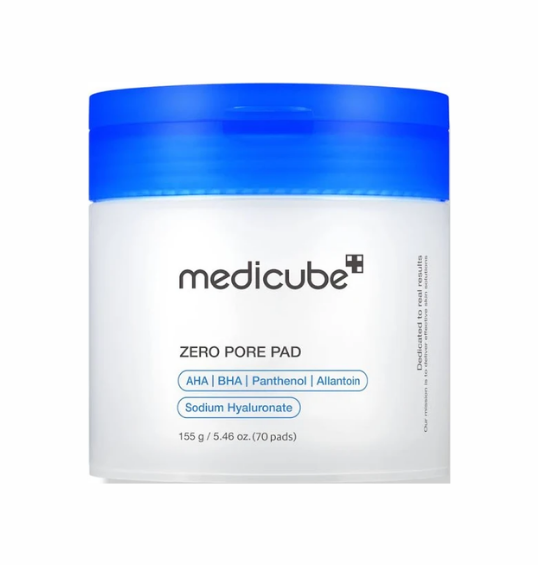
medicube Toner Pads Zero Pore Pad 2.0
Medicube's bestselling toner pad, formulated with AHA and BHA to exfoliate, refine pores and clear away excess oil and impurities. The dual textured pad combines a textured exfoliating side with a smooth, soothing side infused with panthenol for hydration and calm. Suited to normal, combination and oily skin, particularly where texture, blackheads or congestion are a concern.
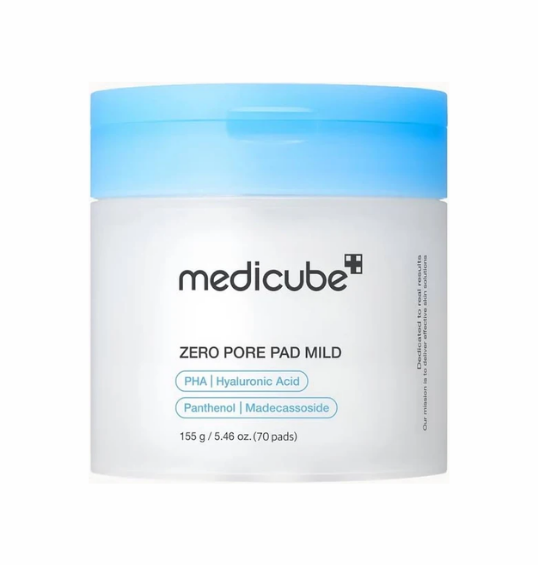
medicube Toner Pads Zero Pore Pad Mild 2.0
A gentler take on Medicube's popular Zero Pore Pad, formulated with PHA rather than the stronger AHA/BHA blend, making it suitable for sensitive or reactive skin. The dual textured pad exfoliates on one side and soothes on the other, with panthenol and madecassoside to calm and support the skin barrier. A good option for daily use or for anyone building up tolerance to exfoliating acids.
Why the heck do we need to exfoliate anyway?
Can’t our skin just operate perfectly well in standard mode?
Sort of yes. Sort of no.
I often say: never has an eight-year-old returned from a long day out and announced that they think their skin is looking a bit dull and tired.
And there is a reason for that.
Our epidermis is constantly renewing itself. New keratinocytes are produced in the deeper layers and gradually move towards the surface, eventually becoming part of the stratum corneum before being shed.
But that process changes as we age.
We often think of “metabolism slowing down” as purely a body-weight or gut conversation, but metabolic and renewal processes happen throughout the body. Skin is no exception. Epidermal proliferation and turnover become slower with age, and changes in desquamation, hydration and barrier function can contribute to skin looking rougher, duller and less reflective.
You will often see the famous “28-day skin cycle” quoted online as though every human face operates according to a tiny calendar. It’s more complicated than that. Turnover varies with age, skin site, health and individual biology.
But the general principle is sound: younger skin renews more efficiently, and that process becomes less efficient as we age.
This is where exfoliation can be genuinely useful.
We are essentially helping along a process the skin already performs itself — encouraging the removal of cells that have, quite frankly, outstayed their welcome.
And these days we have far more sophisticated ways of doing that than attacking our faces with crushed apricot kernels.
Enter acids.
AHA, BHA and PHA
These are three groups you will see crop up again and again in skincare.
AHAs — Alpha Hydroxy Acids
Think glycolic acid, lactic acid and mandelic acid.
These are primarily water-soluble exfoliating acids that work at the surface of the skin, helping loosen the bonds between old corneocytes so they can shed more effectively.
Glycolic is the tiny but mighty one. Its small molecular size means it penetrates efficiently and it can be fantastic for texture, dullness and pigmentation — but that efficiency also means some skin finds it a bit much.
Lactic acid is generally a little more forgiving and has useful humectant properties alongside its exfoliating action.
Mandelic acid has a larger molecular structure and penetrates more slowly, which can make it an interesting option when we want exfoliation with a little more restraint.
BHA — Beta Hydroxy Acid
In skincare, we are mainly talking about salicylic acid.
Unlike AHAs, salicylic acid is oil-soluble. That makes it particularly useful where oil, congestion and pores are part of the conversation because it can work within the oily environment of the follicle.
Acne-prone skin. Blackheads. Congestion. Oily skin.
Salicylic is an absolute workhorse.
PHA — Polyhydroxy Acids
These are the gentler cousins of AHAs. Their larger molecular structure means they penetrate the skin more slowly, so they tend to cause less irritation. They also have humectant and antioxidant properties.
For sensitive or reactive skin — or simply someone who does not need to exfoliate their face into another dimension — PHAs can be brilliant.
And that brings me back to Medicube.
Why do we all love a pad?
Because Medicube took the bull by the horns and made something we all secretly want from skincare:
A simple step.
No faffing.
We hate faffing.
You open the tub. There are 70 properly drenched pads, nicely contained, ready to go.
Cleanse. Pad. Bosh.
Done.
And I think this convenience is part of the reason they have become so popular.
But here is the kicker.
Some of them are pretty punchy. And I don't think there is enough conversation about the fact that the different versions are actually DIFFERENT.
The dark blue ones
These are the ones I hear about constantly.
The AHA/BHA Zero Pore Pads.
And I like them.
They are a strong contender for the right skin. They combine chemical exfoliation aimed at surface texture with salicylic-acid-based pore and congestion support.
But yes — they can be powerful in the context of somebody's whole routine.
Someone comes into clinic and tells me they have sensitive skin.
We talk.
Then we realise perhaps they don't naturally have sensitive skin at all.
They have sensitised skin.
Then we dig a little further and discover they're using exfoliating pads morning and night, seven days a week, alongside a retinoid, a brightening serum containing another acid and something else they didn't even realise was exfoliating.
And it's a fairly safe bet to say the twice-daily acid pads aren't helping matters.
Because more exfoliation does not automatically equal better skin.
I LOVE a good exfoliation.
At 42, through the thick darkness of menopause, exfoliation is absolutely my friend.
But with caution into the night.
If you have normal, tolerant skin, a good functioning barrier and you are certain you aren't unexpectedly layering three other exfoliating products into your routine, then yes.
DO IT.
Be brave and bold and beautiful.
But perhaps do it a few nights a week.
Maybe twice.
Maybe even once.
Your skin does not award bonus points for using the strongest product as frequently as physically possible.
Then we have the light blue ones
And these are the ones I wish more people knew existed.
These lean into PHA-based exfoliation, which can be a much better conversation for skin that needs gentle help with texture and surface cell turnover without the same level of exfoliating aggression.
Same principle.
Cleanse. Pad. Move on with your life.
A couple of times a week may be plenty to begin with, and you can adjust according to what your skin actually does rather than what TikTok tells you it should tolerate.
Because this is probably my ultimate sentiment when it comes to acids:
The dose makes the poison.
Finding an exfoliant that your skin tolerates, that does the job you need it to do, but doesn't do more than it needs to do, is a very good place to start.
You may absolutely love the idea of an AHA/BHA combination in the dark blue tub.
But if every time you use it — even once a week — your skin feels a little shocked afterwards, why are we forcing it?
If your skin comfortably tolerates the gentler PHA version more frequently, then in practice, that may be far more beneficial for your skin than intermittently battering it with something stronger.
Strongest does not mean best.
Appropriate means best.
And yes, then there are the kojic ones.
That cute yellow-ish flavour.
Completely different conversation again because now we are moving beyond straightforward exfoliation and properly into the world of pigmentation pathways and brightening ingredients.
And I have far too much to say about kojic acid to shove it onto the end of this.
So they can have their own review.
Peace.
