
The one where I accidentally write War and Peace about a serum
I bloody love writing.
I mean, Keats and Yeats and Hardy and Brontë all get a full yes from me. If you'd told me a few years ago that one day I'd be writing what essentially amounts to War and Peace on vitamin C—L-ascorbic acid, derivatives, formulations, suspensions, packaging, oxidation and light stability—I would have laughed in your face.
And yet, here we are. Talking about vitamin C.
We've already talked about acids, haven't we? So we're beyond the absolute basics now. We know we're interested in brightening, more even-looking skin tone, post-blemish marks, pigmentation, clarity and radiance.
When somebody comes into clinic and they've nailed the foundations, that's when this conversation becomes interesting.
They cleanse properly. They moisturise. Their barrier is happy. They exfoliate sensibly. And by God, they wear their SPF every single day.
At that point my mind generally goes in one of two directions.
Vitamin A.
Or vitamin C.
Today, it's vitamin C.
And if you're building a long-term skin routine, particularly from your thirties onwards, I absolutely think vitamin C deserves a conversation.
But there is a catch.
We recommend…
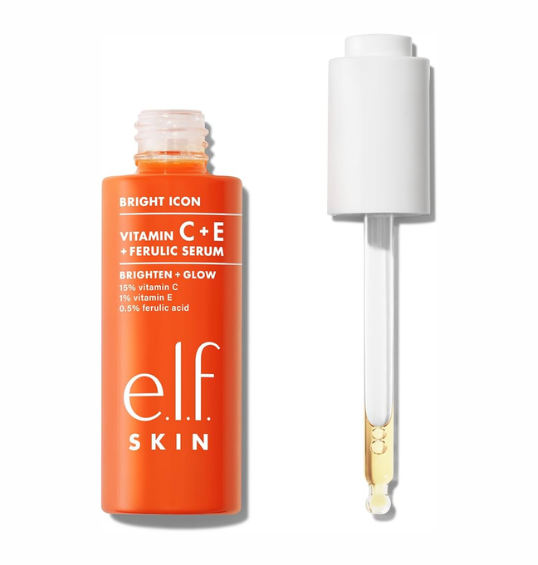
e.l.f. SKIN Bright Icon Vitamin C + E + Ferulic Serum
An antioxidant serum combining 15% vitamin C, 1% vitamin E and 0.5% ferulic acid, a formulation modelled on the well established vitamin C, E and ferulic acid chemistry used in higher end brightening serums. Lightweight and fast absorbing, it is designed to even out skin tone, soothe and support skin already showing signs of dullness or uneven pigmentation. A budget friendly entry point to this type of antioxidant combination.
Vitamin C is that friend at the bar.
First wine? Lovely.
Second? Still absolutely fine.
A few more and suddenly they're standing on the table making questionable life choices.
Vitamin C is much the same.
It's brilliant. It's incredibly well researched. It has decades of evidence behind its antioxidant activity and its role in supporting collagen synthesis and helping improve the appearance of pigmentation and overall skin tone.
But L-ascorbic acid is also spectacularly unstable.
It doesn't particularly like oxygen.
Or light.
Or heat.
Or sitting around in water waiting patiently for you to finish the bottle.
And that's what makes formulating a genuinely brilliant vitamin C so difficult.
It's not enough to put vitamin C into a bottle and shout 20% on the front.
L-ascorbic acid vs vitamin C derivatives - this is probably the most important distinction in the whole conversation.
L-ascorbic acid is the active form of vitamin C. It's the form with the huge body of research behind it and doesn't require conversion into another vitamin C form before it can function as ascorbic acid in the skin.
Brilliant. But remember our drunk friend. Unstable.
So cosmetic chemists have developed derivatives of vitamin C that sacrifice some of that simplicity in exchange for things we rather like in skincare: stability, longevity and often better tolerability.
You'll see names like:
Sodium Ascorbyl Phosphate (SAP) — stable, gentle and particularly interesting in blemish-prone skin.
Magnesium Ascorbyl Phosphate (MAP) — another stable derivative that can be a sensible option for more sensitive skin.
Ascorbyl Glucoside — a stable, water-soluble derivative commonly used in brightening formulations.
3-O-Ethyl Ascorbic Acid — an interesting newer-generation option combining improved stability with good brightening potential.
Tetrahexyldecyl Ascorbate (THD) — oil-soluble, stable and used in some really elegant formulations.
And here's the important bit.
A derivative isn't automatically a worse vitamin C.
Sometimes it's actually the smarter vitamin C.
Particularly if you have rosacea or sensitive skin.
This is where I will always choose the skin in front of me over an ingredient hierarchy.
If your skin is reactive, rosacea-prone, barrier-impaired or simply doesn't tolerate acidic formulations particularly well, I am not interested in forcing you through months of stinging and redness simply so we can say you're using "pure" L-ascorbic acid.
We're talking about skincare that I potentially want you using for years.
Consistency wins.
A beautifully tolerated derivative that you can use every morning for the next decade may be a far better choice for your skin than a powerful low-pH L-ascorbic acid serum that leaves you flushed, irritated and eventually sitting untouched in a drawer.
And if your skin is currently angry?
Sometimes the correct vitamin C is no vitamin C yet.
Barrier first. Always.
So which vitamin C did I actually like?
Gosh, this has taken me forever.
I wanted to love the Dermalogica one. I wanted to find something that could genuinely challenge SkinCeuticals C E Ferulic.
Because God, we don't want to be spending around £165 every four to six weeks on vitamin C.
Like, no.
We do not need that.
Especially when I'm telling you this is potentially something we're going to put on our face every morning for years.
So finding a brilliant vitamin C that doesn't cost the same as a small household appliance became something of a mission.
First: packaging matters.
I tested a La Roche-Posay vitamin C and initially there were things I really liked. Then about two weeks in I looked at the inside of the seal around the pipette.
Brown. Not slightly beige. Brown.
It looked like sun cream you'd left in your suitcase for eighteen months since your last holiday.
Now, that doesn't allow me to declare that the entire bottle had suddenly become useless. Oxidation around a dropper where product repeatedly meets air isn't the same thing as laboratory analysis of the serum inside.
But it demonstrates the problem beautifully.
Oxidation is happening.
Suddenly packaging isn't just packaging.
It's part of the formulation.
Then came Dermalogica.
I tried the BioLumin-C Serum and BioLumin-C Eye Serum and genuinely wanted them to be the ones.
There were things I liked.
But pulling apart the face formulation also gave me another reminder of why I bang on about reading entire ingredient lists rather than simply the hero ingredient on the front.
Lactic acid.
Sneaky little acid.
Not bad. Lactic acid can be fabulous.
But imagine you're already using an exfoliating acid elsewhere, perhaps you've got another acid hiding in your cleanser, then you've got this, and then you've introduced your retinoid...
Suddenly your beautifully considered skincare routine has turned into an acid rave.
Please refer to my previous War and Peace on acids.
And then came the surprise.
Holy Lord.
And it really couldn't be better because it rhymes with shelf.
e.l.f.
I did not expect this one. And perhaps that's why I enjoyed finding it so much. It ticked the boxes I actually care about when I'm assessing a vitamin C. Not simply:
DOES IT CONTAIN VITAMIN C?
But:Which form? How is it formulated? What's sitting alongside it? How is it protected? What does the packaging look like? What does it feel like on the skin?
And, rather importantly, what does the bloody thing look like three weeks after I've opened it?
Because something can look magnificent on an ingredient list and still be a formulation disaster in your bathroom. The e.l.f. formulation surprised me.
It was elegant. It behaved beautifully within a routine. I liked the approach to the formulation and packaging.
And most importantly, I actually enjoyed using it consistently and saw enough from it to keep reaching for it. Does that mean SkinCeuticals C E Ferulic suddenly isn't a benchmark formulation?
Absolutely not. There's a reason it has occupied that position for so long.
But do I think you categorically need to spend £165 every month or so to put a decent vitamin C on your face?
No.
And thank God for that. Because if I'm going to tell you to use vitamin C every morning for the next thirty years, I'd quite like you to still be able to afford your mortgage.
THE SHELF VERDICT
Normal, resilient skin:
A well-formulated L-ascorbic acid is still my first conversation.
Sensitive or rosacea-prone skin:
Slow down. Lower strength, a gentler derivative or less frequent use may make far more sense. If it repeatedly burns, stings or creates persistent redness, we're not "pushing through". We're reassessing.
Barrier-impaired or actively irritated skin:
Forget vitamin C for the moment. Fix the foundations first.
And my affordable find?
e.l.f. Vitamin C.
That's the one that's earned its place on The Shelf.
