
Aveeno Calm + Restore Oat Rich Cream - The one that nearly got away
I’m not entirely sure what inspired me to buy this.
I think I was searching for another Cicaplast Baume B5 or Avène Cicalfate+ winner. Neither of which I have actually written up for The Shelf yet, which is slightly ridiculous because they are iconic. And somewhere in that search, this found its way into my life.
Then nearly got forgotten about. Not because I disliked it. Almost the opposite. Its just - not dramatic – either to love or to complain about or anything wildly spectacular to announce.
And perhaps that is how good, uncomplicated moisturisers get overlooked.
They don’t transform your face by Thursday. They don’t arrive with a heroic percentage printed across the jar. They simply make dry, sensitive skin feel softer and more comfortable. So before this one disappeared into the back of my skincare cupboard, I pulled it onto The Shelf.
What we recommend…
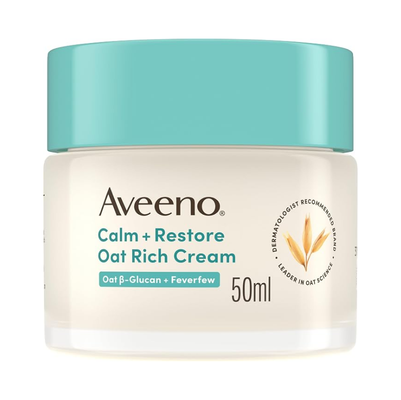
Aveeno Calm+ Restore Oat Rich Cream
A nourishing moisturiser formulated for dry, irritated and sensitive skin, built around Aveeno's Triple Oat formula alongside calming feverfew. Designed to soothe irritation, replenish moisture and support the skin's natural barrier, with a richer texture suited to those needing deeper, longer lasting hydration. Fragrance free and dermatologist tested.
This is a cream, not a rescue balm
Has it replaced Cicaplast or Cicalfate? No. But that may be an unfair competition because it isn’t really trying to be either of them.
Cicaplast and Cicalfate have that heavier, more protective rescue-product quality. They are the products we reach for when skin feels particularly disrupted or needs something more substantial.
Aveeno is softer. It spreads easily, absorbs comfortably and feels much more like a daily moisturiser than a layer of protective scaffolding. It is rich without feeling especially heavy and has no meaningful fragrance that I can detect. That distinction matters.
“Calming”, “restoring” and “barrier support” are not one single product category. A comfortable daily cream and a more occlusive recovery balm may speak similar language, but they do not necessarily perform the same role.
What is actually in it?
The formulation begins with water and glycerin, giving us a straightforward humectant base. Then we have fatty alcohols and emollients these help soften the skin, improve the feel of the cream and reduce moisture loss.
Other ingredients give us a sensible combination of humectants, emollients and more occlusive ingredients. In simpler terms, it helps bring water towards the upper layers of the skin, softens the spaces between skin cells and slows down how readily that water escapes.
Nothing revolutionary. But nicely constructed.
We need to talk about the oat
Aveeno describes this cream as being powered by oat beta-glucan.
Beta-glucan is a polysaccharide with humectant, soothing and film-forming properties. Oat also contains lipids and compounds called avenanthramides, which contribute to its calming and anti-inflammatory activity.
Colloidal oat has a respectable history in products designed for dry, itchy and sensitive skin. But this is where critical reading matters.
Beta-glucan appears quite low in the ingredient list. That does not mean it is ineffective because some ingredients can perform at relatively low concentrations. But we are not given its precise percentage. So “powered by” remains a marketing phrase rather than a concentration statement.
Oat kernel flour appears much higher in the formulation, alongside glycerin, shea butter, sunflower oil and panthenol. Realistically, the comfort this cream provides probably comes from the whole formulation working together, rather than one heroic oat molecule arriving to save the day.
There is another important detail too.
This newer Oat Rich Cream is not the same formulation as Aveeno’s older Oat Rich Balm. The balm contained petrolatum and a ceramide. This cream is lighter and contains neither. That probably explains why it feels more like daily wear and less like a Cicaplast competitor.
Who might like it?
I can see this working well for:
Dry or dehydrated skin
Sensitive or easily irritated skin
Skin experiencing tightness or mild flaking
Someone using retinoids or exfoliating actives who needs a comfortable daily moisturiser
Someone who finds heavier barrier balms too occlusive for everyday use
Anyone wanting fragrance-free barrier support without a complicated active formula
I would not treat it as a medical treatment for eczema, rosacea or dermatitis. Nor would I assume it can repair every significantly compromised barrier by itself. But for daily dryness, sensitivity and maintenance? Yes. It makes sense.
The expensive-oat problem
This is where the review becomes slightly more entertaining. Aveeno is around £15 for 50 ml and is frequently available for less.
First Aid Beauty Ultra Repair Cream is currently around £39 and also builds its soothing story around colloidal oatmeal, glycerin, shea butter and ceramides.
Kate Somerville DeliKate Recovery Cream is around £72 and enters the same stressed-skin conversation with glycerin, oat kernel flour, ceramides and a much more luxurious marketing wardrobe.
These are not identical formulations or direct dupes. Ingredient lists cannot tell us precise concentrations, manufacturing quality, delivery or how the complete formulation will perform on an individual person.
But these products are standing in a very similar area of the skincare party.
Apparently, oat can wear a £15 cardigan, a £39 jumper or a £72 cashmere coat.
The Shelf verdict
There is very little I dislike about this. It is soft, comfortable, fragrance-free and easy to use. It offers a thoughtful mixture of humectants, emollients and soothing ingredients without turning the whole thing into a dramatic barrier emergency.
Has it taken the crown from Cicalfate or Cicaplast?
No.
But it doesn’t need to.
Best for: Dry to very dry, sensitive or easily irritated skin
Size: 50 ml
Typical price: Around £15, often discounted
Shelf status: The one that nearly got away, but quietly earns its place
